Robin Nest - Spring 2020
In our first spring in North Carolina, we were lucky enough to have a family of robins choose a small tree just off our kitchen window as their nest site.
In mid-April, we started noticing
a robin visiting a particular crook in this particular tree throughout the day. She seemed to be curious about vantage points and
visibility. We thought the nest was pretty easy to spot – but it turns out
that, just 2 weeks later, the tree had leafed out enough that the nest was fairly
well hidden.
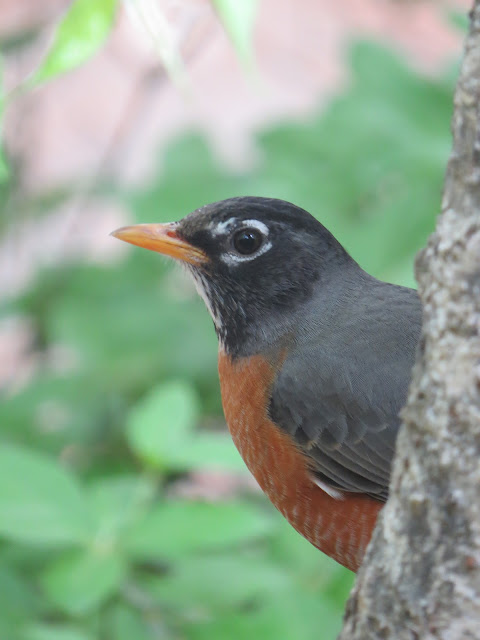 |
| Scouting the location - April 11 |
Robin nests are built by the female, who press dead grass and twig into a cup-like shape.
 |
| Bringing in supplies - April 14 |
Robins will shape the nest using the wrist
of a wing. It looks like a robin sitting down, and rubbing her belly side to side for 30 seconds.
One the twigs are in place, the robin will reinforce its structure using mud and worm castings. The nest is then lined with soft, dry grass.
They will also use other found materials – ours chose some plastic packing ribbon.

The nest is generally 6-8” across and 3-6” high. Ours was higher in the front, which was a clever design in that it prohibited nosy humans from standing on their tip-toes to peek in.
Mating robins will stay together during an entire breeding season, which can involved 2-3 nests per year (sometimes 4). Generally, robins lay one egg per day, with between 5-6 eggs in a clutch. Our nest was not very successful – neither in egg production nor in yield. We saw 3 eggs in total; we know the nest was of tremendous interest to squirrels and to Carolina Wrens, both of which will bother robin eggs that are in their territory. One egg was visibly damaged early on, and only one of the remaining eggs hatched.
 |
First egg - April 27 |
The parent birds were on this nest all day long, taking brief breaks to find their own food.

Robin eggs are laid one per day, and they hatch in the same sequence – one per day, in the order in which they were laid. Generally, hatching doesn’t start until 12-14 days after the last egg was laid. A newly-hatched robin weighs about 5 ½ grams – about as much as a quarter.
 |
Day 2 - May 7 |
We knew an egg had hatched from watching a change in the behavior of the parent -- now they were constantly in and out of the nest, and often bringing back food.

Baby robin eyes remain shut for
the first 5 days. But they are hungry right away. Once a baby has hatched, the
parents will feed it about every 10 minutes during the day. The first 5 days of
life, the parents will regurgitate food into the baby, but soon the new robin
will advance to getting parts of earthworms fed directly to them.
 |
Day 5 - May 11 |
 |
Day 6 - May 11 - Eyes open |
 |
Day 7 - May 13 |
 |
Day 8 - May 14 |
 |
Day 9 - May 15 |
Baby robins will fledge – jump from the nest – at about 13 days of age. Ours fledged at 10 days.
 |
Empty Nest - May 16 |
Generally, the fledglings are not good fliers. Nor are they good at finding their own food. So they stick around and follow their parents for another 10-15 days, until they have developed their wing muscles sufficiently to fly. Baby robins will reach their full adult size after just 14 days after hatching.
What we call a “robin” in the US is member of the thrush family, and is different from the European robin, which is a flycatcher. When Europeans came to the United States and saw a red-breasted bird, they simply called it “robin” since it was visually similar to their European bird.

Comments
Post a Comment